


%20(2).avif)
San Antonio DUI/DWI Defense Attorney
Types of DWI Cases We Handle

First and Second DWI
A first-time DWI is typically a Class B misdemeanor, carrying a maximum of 180 days in jail, while a second offense is elevated to a Class A misdemeanor, with mandatory jail time as a condition of probation. These "standard" charges are deceptively serious because a conviction results in a permanent criminal record that cannot be expunged. We examine every detail of your arrest, from the initial traffic stop to the calibration of the breathalyzer, to identify weaknesses in the prosecution's case and fight for a reduction to a non-DWI offense.

Felony DWI (3rd or More)
Texas law treats habitual intoxication seriously; a third DWI charge is classified as a third-degree felony, regardless of how much time has passed since your previous convictions. These cases carry a potential prison sentence of 2 to 10 years in a state facility and a fine of up to $10,000. Our defense focuses on scrutinizing the validity of your prior convictions and challenging the current evidence to protect you from the life-altering consequences of a felony record.

DWI with Child Passenger
In Texas, driving while intoxicated with a passenger under the age of 15 is automatically charged as a state jail felony. This applies even if it is your very first arrest and no accident occurred. A conviction can lead to up to two years in state jail, the loss of your right to possess a firearm, and significant complications regarding parental rights and professional licensing.

Minor DUI (Under 21)
Texas enforces a "Zero Tolerance" policy for drivers under 21. A minor can be charged with DUI if they have any detectable amount of alcohol in their system, even if they are not legally "intoxicated". While these are typically Class C misdemeanors, they can result in a criminal record that can derail college applications and early career prospects, making an aggressive defense essential to protecting a young person's future.

Intoxication Assault and Manslaughter
These are the most severe intoxication crimes in the Texas Penal Code, triggered when a DWI results in "serious bodily injury" or the death of another person. Intoxication Assault is a third-degree felony, while Intoxication Manslaughter is a second-degree felony. We utilize accident reconstruction experts and medical forensic analysis to challenge the prosecution's claim that intoxication, rather than external road factors, was the direct cause of the incident.

Boating While Intoxicated (BWI)
Operating a watercraft while intoxicated is a crime in Texas with penalties that mirror a standard DWI. Whether you were on Medina Lake or the Guadalupe River, a BWI arrest carries the same risk of jail time and permanent criminal records. Because "stops" on the water often lack the "reasonable suspicion" requirements of a road traffic stop, we frequently find unique constitutional avenues to challenge these arrests.
.avif)
.avif)
Save Your License Before the Deadline
DWI charges in Bexar County move fast. You have exactly 15 days from the date of your arrest to request an ALR hearing to save your license. Our aggressive defense team is available 24/7 to intervene.

DUI & DWI Laws in Texas
Driving While Intoxicated (DWI) involves operating a vehicle in a public place while lacking the normal use of mental or physical faculties due to alcohol or drugs, or having a Blood Alcohol Concentration (BAC) of 0.08% or higher. In San Antonio, "public place" is broadly defined to include grocery store parking lots, apartment complexes, and shopping mall garages.
Driving Under the Influence (DUI) is a distinct charge specifically for minors under 21 who operate a vehicle with any detectable amount of alcohol in their system.
What Makes San Antonio Different
San Antonio is uniquely positioned with heavy enforcement across multiple jurisdictions, making it a hotspot for intoxication arrests.
- SAPD and the Bexar County Sheriff’s Office conduct frequent "no-refusal" operations along the I-35 and Loop 1604 corridors.
- San Antonio is home to several major military installations, and DWI arrests on base often lead to federal prosecution rather than state charges.
- Bexar County utilizes specialized "Problem Solving Courts" for repeat offenders who require high-intensity monitoring and treatment.
State DWI Charges
State charges are handled by the Bexar County District Attorney’s office in local county courts at law for misdemeanor DWIs and criminal district courts for felony DWIs.
Texas DWI Penalties: What You're Facing
Penalties vary dramatically based on your prior record and BAC levels.
Misdemeanor DWI
- First offense (class B): Up to 180 days in jail, $2,000 fine, and license suspension up to 1 year.
- BAC 0.15% or higher (class A): Up to 1 year in jail and a $4,000 fine.
- Second offense (class A): 30 days to 1 year in jail and a $4,000 fine.
Felony DWI
- DWI with child passenger: 180 days to 2 years in state jail and up to $10,000 fine.
- Third offense or more: 2 to 10 years in prison and up to $10,000 fine.
Enhancement Factors
- Open container of alcohol in the vehicle.
- Causing serious bodily injury or death.
- Prior felony convictions.
First-Offense DWI Defense in Texas
A first-offense DWI in Texas is a serious charge—but it does not have to define your future. At Fowlks Law Firm, we focus on protecting your record, your freedom, and your long-term opportunities. Whether you are facing a Class B misdemeanor DWI or an enhanced Class A charge due to a BAC of 0.15% or higher, we work aggressively to pursue the best possible outcome.
Avoiding Jail: Probation and Deferred Adjudication
Many first-time DWI cases can be resolved without serving jail time. Depending on the facts of your case, we may be able to secure community supervision (probation) instead of incarceration.
There are two key types of probation in Texas:
- Straight Probation (Post-Conviction): A conviction is entered, but jail time is suspended while you complete court-ordered conditions.
- Deferred Adjudication: No conviction is entered. If successfully completed, your case is dismissed.
For eligible first-time offenders, deferred adjudication is often the preferred outcome because it can lead to a nondisclosure, allowing you to seal your record from public view after a waiting period.
Veteran-Focused DWI Defense
At Fowlks Law Firm, we are proud to represent those who have served. If you are a veteran facing a DWI charge, you may qualify for a Veterans Treatment Court program—a specialized court designed to address underlying issues such as PTSD, substance use, or service-related challenges.
When there are no viable constitutional defenses to challenge the traffic stop or arrest—and the client is seeking the best possible resolution—we actively work to advocate for our veteran clients’ admission into Veterans Court. Successful completion of the program can result in reduced penalties and, in most cases, a dismissal of the charge.
Strategic Defense from Day One
Every DWI case begins with a careful analysis of the stop, arrest, and evidence. If there are constitutional issues, such as an illegal stop or improper procedures, we pursue dismissal aggressively. If not, we shift focus to securing the most favorable resolution available—whether that means deferred adjudication, probation, or entry into a specialty court program like Veterans Court.
Defense Strategies That Work
Every DWI case in Bexar County presents unique opportunities to challenge the government’s narrative and protect your rights. Our defense focuses on these critical areas:
Constitutional Violations
Law enforcement must adhere to strict Fourth Amendment standards during a traffic stop. Common violations we investigate include:
- Illegal stops: Police must have "reasonable suspicion" of a crime or traffic violation to pull you over; weaving within a lane is often insufficient for a legal stop.
- Lack of probable cause: An officer cannot arrest you for DWI based solely on the smell of alcohol; they must demonstrate significant impairment.
- Miranda rights violations: If you were interrogated while in custody without being read your rights, your statements may be inadmissible.
Challenging the Evidence
DWI cases rely heavily on technical data that is frequently prone to human or mechanical error.
- Breathalyzer inaccuracy: We subpoena maintenance logs to determine whether the Intoxilyzer 9000 was properly calibrated and whether the operator followed the mandatory 15-minute observation period.
- Blood sample contamination: We scrutinize the "chain of custody" and lab procedures to identify issues like fermentation or improper storage that can artificially inflate BAC results.
- Subjective field sobriety tests: Tests like the "one-leg stand" are highly subjective and can be influenced by inner-ear issues, poor lighting, or uneven San Antonio road surfaces.
Suppression Motions
When we identify police errors or constitutional breaches, we file formal motions to suppress the evidence. If the judge agrees that evidence was gathered illegally, it cannot be used against you at trial, often forcing the prosecution to dismiss the case entirely.
Why Choose Fowlks Law Firm
-

Available When You Need Us Most
DWI arrests happen at all hours, often on weekends or holidays. We are available 24/7 because the most critical defense work, such as requesting an ALR hearing and advising you on what to say to investigators, happens in the hours immediately following an arrest.
-

Bilingual Representation
We provide comprehensive legal services in both English and Spanish. We believe every client deserves to discuss their case and understand their options in their native language, so nothing is lost in translation during the complex legal process.
-

Licensed to Post Bond
Justin Fowlks is uniquely licensed to post bonds directly for his clients. This allows us to cut through the red tape of the Bexar County jail system, getting you home to your family faster so we can begin building your defense without delay.
The Legal Process: What to Expect
Immediate Arrest Phase
- Police investigation and arrest
- Miranda rights and questioning
- Administrative License Revocation (ALR) hearing request within 15 days
- Booking and initial detention at Bexar County Jail
- Bond hearing within 48 hours
Investigation and Discovery
- Evidence collection and laboratory testing
- Witness interviews and officer depositions
- Grand jury proceedings for felony DWI charges
- Motion filing and suppression hearings to challenge evidence
Negotiation and Resolution
- Plea bargain discussions with the District Attorney
- Case dismissal opportunities based on legal technicalities
- Trial preparation and strategy development
Trial
- Jury selection and voir dire
- Opening statements and evidence presentation
- Witness cross-examination and expert testimony
- Jury deliberation and verdict
Post-Conviction Options
- Sentence modifications or probation oversight
- Expunction possibilities for dismissed or acquitted cases
- Professional license defense and rehabilitation programs

.avif)
From simple possession to serious trafficking allegations, drug charges can derail your life and career.
.svg)
Call Now to Save Your License and Fight DWI Charges
Meet Justin M. Fowlks
Justin M. Fowlks is a dedicated advocate for those standing at the crossroads of a DWI arrest in San Antonio. Whether challenging a high-BAC blood draw in Bexar County or dealing with the complexities of a federal DWI, Justin’s deep knowledge of Texas traffic and intoxication laws provides his clients with a formidable shield. His hands-on approach ensures that you are never just a case number; instead, you have a bilingual, strategic partner who personally guides you through the legal maze to protect your driver’s license, your career, and your future.
Justin can:
- Be There 24/7
- Give Free Initial Consultation
- Provide Service in Spanish
- Post Your Bond
- Provide Full Personal Attention
- WIN YOUR CASE
Areas We Serve
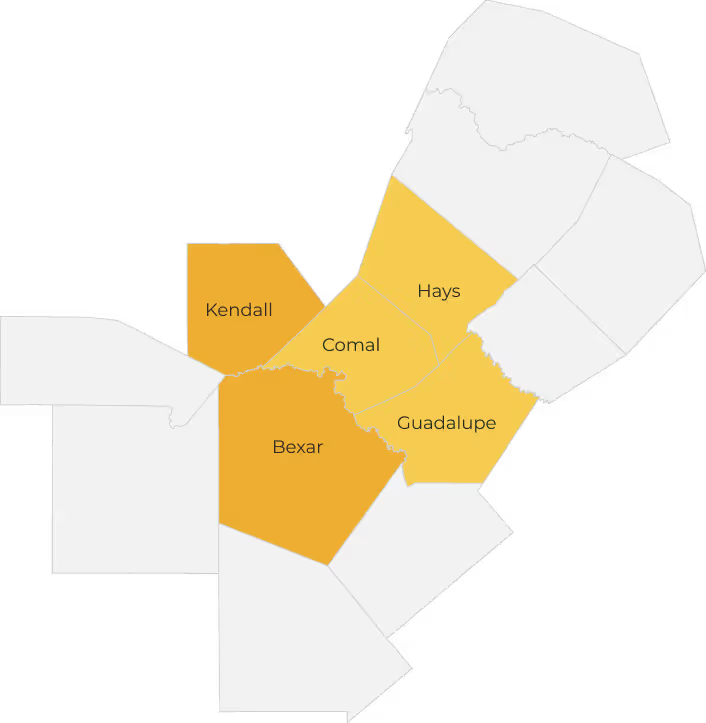
Primary counties:
- Bexar County
- Kendall County
Additional areas:
- Guadalupe County
- Comal County
- Hays County
and surrounding communities.
Frequently Asked Questions
In Texas, DWI (Driving While Intoxicated) applies to adults (21+) who operate a vehicle with a BAC of 0.08% or higher or who have lost the normal use of their mental or physical faculties due to alcohol or drugs. DUI (Driving Under the Influence) is a separate charge specifically for minors under 21 who operate a vehicle with any detectable amount of alcohol in their system. While a DUI is typically a Class C misdemeanor, a DWI is a more serious Class B misdemeanor or higher.
Following a DWI arrest, you have exactly 15 days to request an Administrative License Revocation (ALR) hearing. If you fail to request this hearing within the 15-day window, your driver’s license will be automatically suspended 40 days after your arrest. This hearing is separate from your criminal case and is your only opportunity to contest the suspension of your driving privileges.
Under Texas "implied consent" laws, by driving on public roads, you have already consented to chemical testing if arrested for DWI. If you refuse to provide a sample, your license will be automatically suspended for 180 days (for a first offense). While refusal prevents the state from having immediate chemical evidence, prosecutors can still use your refusal as evidence of "consciousness of guilt" during your trial.
Yes. A DWI can be dismissed if your attorney proves that the police lacked reasonable suspicion for the initial stop or probable cause for the arrest. Additionally, charges are frequently reduced to a non-DWI offense, such as "Obstruction of a Highway," which carries lighter penalties and does not carry the same long-term stigma as an intoxication conviction.
In Texas, a first-offense DWI is typically charged as a Class B misdemeanor, carrying a range of 3 to 180 days in jail, along with fines and other penalties. However, in many cases, an experienced attorney can help a client avoid serving actual jail time by securing community supervision (probation). There are two primary types of probation in Texas: straight probation (post-conviction community supervision) and deferred adjudication.
With straight probation, a conviction is entered, but the jail sentence is suspended while the client completes court-ordered conditions. With deferred adjudication, the court does not enter a finding of guilt; instead, the case is dismissed upon successful completion of probation.
Importantly, under current Texas law, many first-time DWI offenders are eligible for deferred adjudication, and if it is successfully completed, the case may later be eligible for a nondisclosure order, which seals the record from public view (though it remains visible to law enforcement). Eligibility for nondisclosure depends on compliance with all conditions and may involve a waiting period.
If the alleged blood alcohol concentration (BAC) is 0.15% or higher, the charge is enhanced to a Class A misdemeanor, which increases potential penalties to up to one year in jail and higher fines, making strong legal representation even more critical.
In Texas, a DWI conviction remains on your criminal and driving records permanently. It cannot be expunged if you are convicted. However, if your case is dismissed or you are acquitted at trial, you may be eligible for a formal expunction to destroy all records of the arrest. Some first-time offenders may also qualify for a nondisclosure order, which seals the record from public view.

Get Your Case Evaluated for Free
Don't let a DWI charge destroy your future. Our experienced DWI defense team knows how to fight these cases and win. Contact us today for a free case review.
We will contact you shortly.