


%20(2).avif)
San Antonio Violent Crimes Attorney
Violent Crimes We Defend
These charges carry the harshest penalties under Texas and require immediate, aggressive representation.

Murder and Capital Murder
Murder charges involve intentional or knowing conduct that causes another person's death, or conduct clearly dangerous to human life that results in death. Capital murder includes specific aggravating factors like killing a police officer, murder during another felony, or killing multiple people. These cases demand a thorough investigation of forensic evidence, witness statements, and alternative theories. We challenge the state's timeline, scrutinize medical examiner conclusions, and fight to exclude unreliable evidence.

Manslaughter and Criminally Negligent Homicide
Manslaughter involves reckless conduct that causes death, while criminally negligent homicide involves a failure to perceive substantial risks. These charges often arise from accidents, fights that escalate unexpectedly, or situations where death was unintended. We examine whether the state can prove the required mental state and explore whether other factors contributed to the death.

Aggravated Assault
Aggravated assault charges apply when serious bodily injury occurs or when a deadly weapon is used during an assault. These cases frequently involve bar fights, domestic disputes, or self-defense situations. The difference between simple assault and aggravated assault can mean years in prison. We challenge the severity of injuries, question whether weapons were actually used, and present evidence of self-defense or defense of others.

Simple Assault and Assault Family Violence
Simple assault involves intentionally or knowingly causing bodily injury to another person. When the alleged victim is a family member or dating partner, enhanced penalties and protective orders come into play. Many assault cases stem from mutual altercations, false accusations during divorce proceedings, or misunderstandings. We investigate the full context, challenge one-sided accounts, and present evidence that contradicts the state's version of events.

Robbery and Aggravated Robbery
Robbery involves taking property from another person through force or threat of force. Aggravated robbery includes the use of a deadly weapon or causing serious bodily injury during the offense. These charges often rely on victim and witness identifications that can be unreliable. We challenge eyewitness testimony, examine surveillance footage, and investigate whether our clients were even present at the scene.

Kidnapping and Unlawful Restraint
Kidnapping charges involve intentionally or knowingly abducting another person. Unlawful restraint means restricting someone's movement without consent. These accusations sometimes arise from custody disputes, relationship conflicts, or situations where consent is disputed. We examine the alleged victim's statements for inconsistencies and investigate whether the restraint actually occurred.

Terroristic Threat
This offense involves threatening violence with the intent to cause fear or disrupt public activities. Social media posts, heated arguments, and misunderstood statements can all lead to charges. Many terroristic threat cases involve speech protected by the First Amendment or statements made without serious intent. We challenge whether threats were credible, whether intent existed, and whether statements were taken out of context.

Deadly Conduct
Deadly conduct charges involve recklessly engaging in behavior that places others in imminent danger of serious bodily injury, such as discharging a firearm in certain circumstances. These cases often involve accidents, self-defense situations, or lawful gun ownership. We examine whether the conduct was actually reckless and whether the danger was truly imminent.

Burglary of a Habitation
When burglary involves entering a home or dwelling without consent with the intent to commit a felony or assault, it becomes a first-degree felony. These charges frequently accompany assault allegations in domestic situations or rely on assumptions about intent. We challenge proof of unlawful entry, question whether intent existed at the time of entry, and present alternative explanations.

Organized Criminal Activity
Engaging in criminal activity as part of a group or gang can substantially increase penalties. These charges often rely on association evidence rather than proof of actual criminal conduct. We challenge gang allegations, question the reliability of informants, and fight to exclude prejudicial evidence about associations.
.avif)
.avif)
Don't Wait to Build Your Defense
Violent crime charges can lead to decades in prison and a permanent criminal record. Get immediate protection from a San Antonio defense attorney who fights aggressively and knows how to challenge the prosecution's case from every angle.

Texas Penalties for Violent Crimes
Violent crime convictions carry severe prison sentences, substantial fines, and lasting collateral consequences.
- Class A misdemeanor: Simple assault carries a maximum of one year in county jail and fines of $4,000 to $8,000. Assault family violence convictions result in firearms prohibitions.
- Third-degree felony: Deadly conduct, terroristic threats, and some assault cases carry a 2 to 10-year prison sentence and fines up to $10,000.
- Second-degree felony: Manslaughter, aggravated assault with serious injury, and robbery carry 2 to 20 years in prison and fines up to $10,000.
- First-degree felony: Aggravated robbery, aggravated kidnapping, and burglary of a habitation carry 5 to 99 years or life in prison and fines up to $10,000.
- Murder: This first-degree felony carries 5 to 99 years or life in prison and fines up to $10,000. Defendants face mandatory minimum sentences in some circumstances.
- Capital murder: This offense carries either life in prison without parole or the death penalty. Capital cases involve extended trials with separate guilt and punishment phases.
- Enhanced penalties: Prior felony convictions can double minimum sentences or trigger habitual offender laws that mandate life imprisonment. Use of a deadly weapon adds years to sentences.
Collateral Consequences
Beyond prison time, violent crime convictions create lifetime obstacles, including some of the following:
- Permanent criminal records visible to employers;
- Loss of voting rights and firearm ownership;
- Immigration consequences, including deportation for non-citizens;
- Difficulty obtaining housing;
- Negative consequences for your professional license;
- Ineligibility for many jobs and educational opportunities;
- Damaged personal and professional reputations that follow you indefinitely.
Defense Strategies for Violent Crime Cases

Every violent crime case presents opportunities to challenge evidence, protect your rights, and fight for your freedom.
- Self-defense and defense of others: Texas law allows the use of reasonable force to protect yourself or others from unlawful force. We establish that you reasonably believed force was necessary, that you didn't provoke the encounter, and that your response was proportional to the threat. Stand Your Ground laws eliminate any duty to retreat before using defensive force.
- Lack of intent: Many violent crimes require proof of specific intent. We challenge whether you intended the result, whether actions were accidental or reckless rather than intentional, and whether the state can prove the required mental state beyond a reasonable doubt.
- Mistaken identity: Eyewitness identifications are notoriously unreliable, especially in high-stress situations or poor lighting. We challenge identification procedures, present alibi evidence, and demonstrate weaknesses in the certainty of witnesses. Cross-racial identifications and identifications made under stress are particularly unreliable.
- Insufficient evidence: Prosecutors must prove every element of the offense beyond a reasonable doubt. We attack weaknesses in the state's case, identify missing evidence, and demonstrate that assumptions and speculation cannot substitute for proof.
- Illegal searches and seizures: Evidence obtained through unconstitutional searches cannot be used against you. We examine whether officers had proper warrants, whether searches exceeded constitutional limits, and whether consent was truly voluntary. Suppressing key evidence can result in charges being dismissed.
- False accusations: Violent crime accusations sometimes stem from revenge, custody battles, insurance fraud, or attempts to deflect blame. We investigate the accuser's motives, examine relationships among the parties, and identify evidence that contradicts the false claims.
- Constitutional violations: Statements obtained without Miranda warnings, through coercive tactics, or after you requested an attorney cannot be used at trial. We scrutinize every interrogation, challenge questionable police tactics, and fight to suppress illegally obtained confessions.
- Witness credibility issues: We examine witness statements for inconsistencies, investigate witness backgrounds and biases, and assess whether witnesses could have seen what they claim to have seen. Prior inconsistent statements and contradictions undermine credibility.
- Forensic evidence challenges: Medical examiner conclusions, DNA analysis, ballistics reports, and other forensic evidence require scrutiny. We consult independent professionals to challenge methodologies, question conclusions, and identify alternative explanations consistent with innocence.
- Accident defense: Some incidents resulting in injury or death are tragic accidents rather than crimes. We demonstrate a lack of criminal intent, show that the conduct wasn't reckless or negligent, and present evidence that the incident was unforeseeable.
Why Immediate Action Matters

Violent crime investigations move quickly, and early intervention can mean the difference between conviction and freedom.
- Preservation of evidence: Physical evidence degrades, surveillance footage gets deleted, and witnesses' memories fade. Starting your defense immediately preserves evidence that can prove your innocence or challenge the prosecution's theory.
- Witness interviews: Talking to witnesses before police contaminate their memories allows us to gather unbiased accounts. Once witnesses have been interviewed by detectives, their memories become shaped by law enforcement's theory of the case.
- Crime scene investigation: An independent investigation of crime scenes can reveal evidence police may have missed or failed to document. We examine scenes while the evidence is still fresh and take our own photographs and measurements.
- Self-defense claims: Texas law provides procedures for pre-trial hearings on self-defense claims that can result in dismissed charges before trial. These hearings require thorough preparation and immediate action.
- Bond considerations: Violent crime charges often involve high bonds or no bond at all. Early attorney involvement helps secure reasonable bond conditions and demonstrates to courts that you're taking the charges seriously.
- Media and public perception: High-profile violent crime cases attract media attention that can poison potential jury pools. Early intervention allows us to control the narrative and protect your reputation.
The Legal Process for Violent Crime Cases
- Investigation: Law enforcement often makes arrests based on limited evidence. Never speak to detectives without an attorney, even if you are innocent.
- Arrest and booking: After being processed at Bexar County Jail, exercise your right to remain silent. Any statements made to officers will be used against you.
- Magistrate hearing: Within 48 hours, a magistrate sets bond. An attorney can argue for reasonable conditions that allow you to maintain your job and family ties.
- Grand jury: This body determines whether there is sufficient evidence to support formal charges. Your attorney can present evidence to challenge the state’s case and aim to prevent an indictment.
- Arraignment: You will enter a formal plea. Most defendants plead not guilty to keep all defense options open while evidence is reviewed.
- Discovery: Your attorney gathers police reports, witness statements, and forensic data. This phase identifies flaws in the prosecution's case.
- Pre-trial motions: We file motions to exclude illegally obtained evidence or to dismiss charges. Success here can lead to reduced charges or a full dismissal.
- Plea negotiations: We explore settlement options with prosecutors while preparing for trial if the state refuses to offer a fair resolution.
- Trial preparation: We interview witnesses, consult forensic sources, and build cross-examination strategies to ensure a strong defense.
- Trial: Prosecutors must prove guilt beyond a reasonable doubt. We challenge their witnesses and present your defense during the proceedings.

.avif)
From simple possession to serious trafficking allegations, drug charges can derail your life and career.
.svg)
Meet Justin M. Fowlks
Justin M. Fowlks provides aggressive defense for clients facing the most serious charges in the criminal justice system. His experience handling violent crime cases, from assault to murder, gives clients confidence when their freedom and future are on the line.
These cases require an attorney who fights aggressively from the first court appearance through trial. Justin provides personal attention to every client, returning calls promptly, explaining options clearly, and fighting to protect their rights at every stage.
Justin can:
- Be There 24/7
- Give Free Initial Consultation
- Provide Service in Spanish
- Post Your Bond
- Provide Full Personal Attention
- WIN YOUR CASE

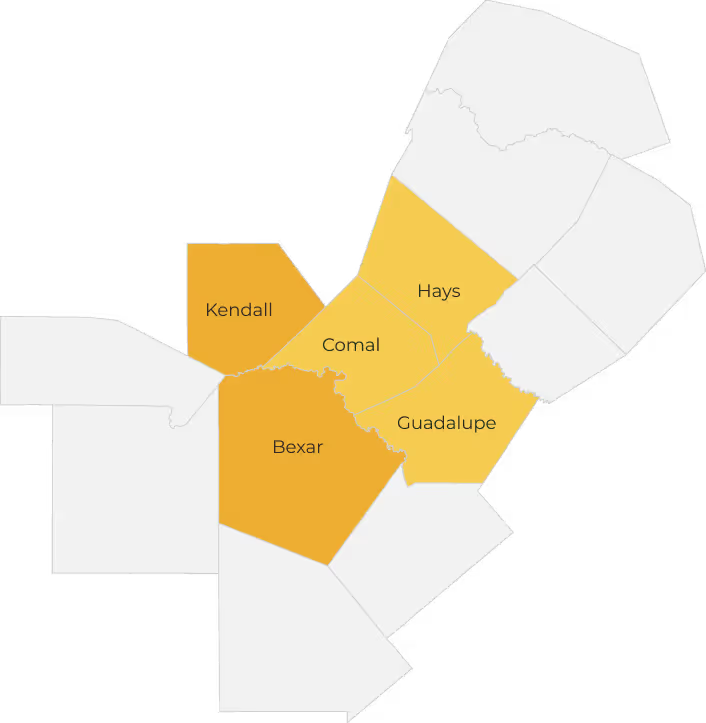
Areas We Serve
Primary counties:
- Bexar County
- Kendall County
Additional areas:
- Guadalupe County
- Comal County
- Hays County
and surrounding communities.
Frequently Asked Questions About Violent Crimes
Politely decline to answer questions and request an attorney immediately. Even innocent explanations can be twisted into incriminating statements. Police are trained to elicit confessions and admissions, and they're allowed to lie during interrogations. Remaining silent cannot be used against you, but anything you say will be documented and presented to prosecutors.
Yes, charges can sometimes be reduced through negotiations, successful pre-trial motions, or by demonstrating weaknesses in the state's case. Murder can be reduced to manslaughter, aggravated assault to simple assault, and robbery to theft. Each case depends on the specific facts, the quality of the evidence, and the witness's credibility.
Texas law recognizes self-defense as a complete defense to violent crime charges. You can use reasonable force to protect yourself from unlawful force, with no duty to retreat in most circumstances. We can file for a pre-trial hearing in which the judge determines whether self-defense applies, potentially resulting in the dismissal of charges before trial.
Bond availability depends on the specific charges and your criminal history. Murder and capital murder cases may involve no bond or extremely high bonds. Lesser violent crimes typically allow bond with conditions like electronic monitoring, no contact orders, and weapon surrenders. An attorney can argue for a reasonable bond based on your ties to the community and lack of flight risk.
Violent crime cases typically take 12 to 24 months from arrest to resolution. Cases involving complex forensic evidence, multiple witnesses, or serious injuries often take longer. Cases that go to trial take longer than negotiated resolutions. Capital murder cases can take several years due to extensive pre-trial litigation.
Yes, convictions can be based solely on witness testimony, even without physical evidence, DNA, weapons, or other forensic evidence. However, cases lacking physical evidence are more vulnerable to defense challenges. We attack witness credibility, demonstrate inconsistencies, and show reasonable doubt when physical evidence is absent.

Fight for Your Freedom Today
Violent crime convictions destroy families, careers, and futures. You need an attorney who fights aggressively from day one and refuses to back down when prosecutors want to put you in prison for years or decades.
Contact Fowlks Law Firm today for your free consultation. Attorney Justin Fowlks is available 24/7 to begin protecting your rights and building your defense. Don't wait, because the sooner we start, the stronger your defense becomes. Call now.
We will contact you shortly.