

%20(2).avif)
San Antonio Drug Distribution & Trafficking Defense Attorney
Against Federal & State Drug Charges
Drug Distribution & Trafficking Laws in Texas
Drug distribution involves the sale, delivery, or transfer of a controlled substance to another person. Drug trafficking generally refers to larger-scale operations involving substantial quantities of narcotics, organized activity, or the movement of drugs across state or international lines. Given San Antonio’s location along the I-35 corridor, these cases frequently attract federal law enforcement involvement and often carry significantly enhanced penalties.
What Makes San Antonio Different
San Antonio sits at the center of one of the nation's most heavily monitored drug trafficking routes. The city's proximity to the Mexican border and position along Interstate 35 make it a focal point for both state and federal drug enforcement. This means:
- Multiple law enforcement agencies operate in the area.
- Federal task forces conduct regular operations.
- Penalties are often enhanced for border-related crimes.
- Cases frequently involve wiretaps and undercover operations.
State vs. Federal Drug Charges
State charges are prosecuted by the Bexar County District Attorney's office and handled in local courts. These typically involve smaller quantities and local distribution networks.
Federal charges are prosecuted by the U.S. Attorney's Office and carry mandatory minimum sentences. Federal cases often involve:
- Interstate transportation of drugs
- Large quantities that cross federal thresholds
- Conspiracy with multiple defendants
- Use of firearms in drug crimes
Types of Drug Cases We Handle
Texas Drug Penalties: What You're Facing
Texas classifies controlled substances into penalty groups, with punishments varying dramatically based on the type and amount of drug involved.
Penalty group 1: Cocaine, heroin, methamphetamine, LSD, oxycodone, fentanyl.
- Less than 1 gram: State jail felony (180 days-2 years + $10,000 fine)
- 1-4 grams: 3rd degree felony (2-10 years + $10,000 fine)
- 4-200 grams: 2nd degree felony (2-20 years + $10,000 fine)
- 200-400 grams: 1st degree felony (5-99 years in a state prison or life + $100,000 fine)
- 400 grams or more: Enhanced 1st degree felony (10-99 years or life + $100,000 fine)
Penalty group 1-A: Acid, LSD, or analogues of LSD.
- 1-20 units: State jail felony (180 days-2 years + $10,000)
- 20-80 units: 3rd degree felony (2-10 years + $10,000)
- 80-4,000 units: 2nd degree felony (2-20 years + $10,000)
- 4,000-8,000 units: 1st degree felony (5-99 years + $100,000)
- 8,000 units or more: Enhanced 1st degree (15-99 years + $250,000)
Penalty group 1-B: Fentanyl, along with its components.
- Under 1 gram: State Jail Felony (180 days–2 years + $10,000 fine)
- 1-4 grams: 3rd degree felony (2-10 years in prison + $10,000 fine)
- 4-200 grams: 2nd degree (2-20 years in prison + $10,000 fine)
- 200-400 grams: 1st degree (5–99 years in prison or life + $10,000 fine)
- Over 400 grams: Enhanced 1st degree (10–99 years in prison or life + $10,000 fine)
Penalty group 2: MDMA/Ecstasy, PCP, amphetamines, hashish, synthetic cannabinoids (K2/Spice).
- Less than 1 gram: State jail felony (180 days-2 years + $10,000 fine)
- 1-4 grams: 3rd degree felony (2-10 years + $10,000 fine)
- 4-400 grams: 2nd degree felony (2-20 years + $10,000 fine)
- 400 grams or more: Enhanced 1st degree felony (5-99 years + $50,000 fine)
Penalty group 2-A: Synthetic marijuana, spice, K2, and other synthetic cannabinoids.
- Less than 2oz: Class B misdemeanor (180 days in jail + $2,000 fine)
- 2oz.-4oz.: Class A misdemeanor (0-1 year in county jail +$4,000 fine)
- 4oz.-5 pounds: State jail felony (180 days-2 years + $10,000 fine)
- 5 pounds-50 pounds: 3rd degree felony (2-10 years in a state prison +$10,000)
- 50 pounds-2,000 pounds: 2nd degree felony (2-20 years in a state prison +$10,000)
- 2,000 pounds or more: Enhanced 1st degree felony (5-99 years in state prison or life +$50,000
Penalty group 3: Prescription medications Xanax, Valium, codeine, anabolic steroids, etc., without a proper prescription.
- Less than 28 grams: Class A misdemeanor (up to 1 year + $4,000 fine)
- 28-200 grams: 3rd degree felony (2-10 years + $10,000 fine)
- 200 grams-400 grams: 2nd degree felony (2-20 years in a state prison +$10,000)
- 400 grams or more: Enhanced 1st degree felony (5-99 years in state prison or life +$50,000)
Penalty group 4: Opium, Morphine, Motofen, etc. (without a valid prescription)
- Less than 28 grams: Class B misdemeanor (up to 180 days + $2,000 fine)
- 28g-200g: 3rd degree felony: (2-10 years in a state prison and/or a +$10,000)
- 200g-400g: 2nd degree felony: (2-20 years in a state prison and/or +$10,000)
- 400g or more: Enhanced 1st degree felony (5-99 years in state prison or life +$50,000)
Enhancement Factors That Increase Penalties
- Delivering drugs to minors
- Distribution near schools or playgrounds
- Use of weapons during drug crimes
- Prior felony convictions
#cta_start
Your Freedom Can't Wait. Call Now.
Drug charges move fast in San Antonio. Every day you wait is another day prosecutors build their case against you. Our aggressive defense team is standing by 24/7 to protect your rights and fight for your freedom.
#cta_end
Defense Strategies That Work
Every drug case is different, but successful defenses often focus on these key areas:
Constitutional Violations
Law enforcement must adhere to strict protocols when investigating drug crimes. Common violations include:
- Illegal searches of vehicles or homes
- Traffic stops without reasonable suspicion
- Failure to obtain proper warrants
- Coercive interrogation tactics
- Miranda rights violations
Challenging the Evidence
Drug cases rely heavily on physical evidence, which can be attacked in several ways:
- Chain of custody problems
- Improper testing procedures
- Contaminated or degraded samples
- Lack of knowledge or intent to distribute
- Entrapment by law enforcement
Suppression Motions
When police violate your constitutional rights, the evidence they gather can be suppressed (thrown out). Without key evidence, prosecutors often cannot prove their case beyond a reasonable doubt.
Why Choose Fowlks Law Firm
-

Available When You Need Us Most
Drug arrests happen around the clock. That's why we're available 24/7 to take your call and begin working on your case immediately. Time matters in drug cases, and early action can make the difference between conviction and freedom.
-

Bilingual Representation
We provide complete legal services in both English and Spanish. Many of our clients prefer to discuss their cases in their native language, and we ensure clear communication throughout the entire process.
-

Licensed to Post Bond
Unlike most attorneys, Justin Fowlks is licensed to post bonds directly. This means we can get you out of jail faster and begin preparing your defense without delay. We handle the paperwork and get you home to your family.
-

Experienced in Both State and Federal Courts
Drug cases can be prosecuted at either the state or federal level. We regularly practice in:
- Bexar County District Courts
- U.S. District Court, Western District of Texas
- Kendall County Courts
- Guadalupe County Courts
- Federal Court of Appeals, Fifth Circuit
The Legal Process: What to Expect
Federal vs. State Drug Prosecutions

.avif)
From simple possession to serious trafficking allegations, drug charges can derail your life and career.
.svg)
Meet Justin M. Fowlks
Justin M. Fowlks has built a reputation defending clients against serious drug distribution and trafficking charges throughout Bexar County and surrounding areas. His thorough case preparation and strategic defense approach have helped hundreds of clients facing federal and state drug trafficking allegations. Justin combines aggressive courtroom advocacy with compassionate client support, ensuring each person receives dedicated representation during these challenging times.
Justin can:
- Be There 24/7
- Give Free Initial Consultation
- Provide Service in Spanish
- Post Your Bond
- Provide Full Personal Attention
- WIN YOUR CASE

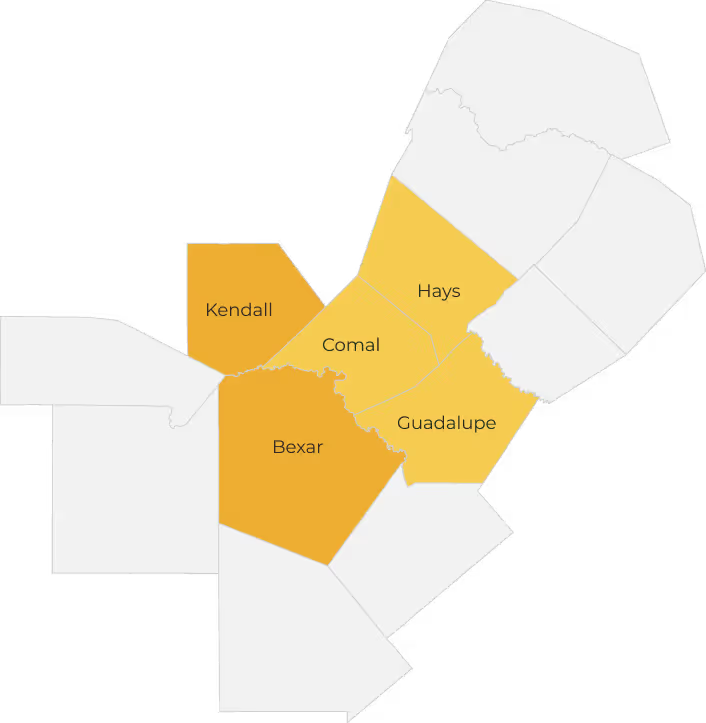
Areas We Serve
Primary counties:
- Bexar County
- Kendall County
Additional areas:
- Guadalupe County
- Comal County
- Hays County
and surrounding communities.
frequently asked questions
Possession involves having drugs for personal use, while distribution involves selling, delivering, or transferring drugs to others. The distinction often depends on the quantity found and evidence of sales activity, like scales, packaging materials, or large amounts of cash.
Yes, through skilled negotiation and aggressive defense work. Common reductions include trafficking to simple possession, felonies to misdemeanors, or complete dismissal when evidence is suppressed.
Police need reasonable suspicion to stop your vehicle and probable cause to search it. If they violate these requirements, any evidence found can be suppressed. Never consent to a search - make them get a warrant.
Federal cases typically involve larger quantities, interstate activity, or conspiracy. They carry mandatory minimum sentences and are prosecuted by U.S. Attorneys rather than local district attorneys.
Do not consent to a search. Ask to see a warrant, and if they don't have one, clearly state that you do not consent. Contact an attorney immediately before answering any questions.
Physical evidence can be challenged in many ways. If police violated your rights during the evidence-gathering process, the evidence may be suppressed. We also challenge the testing, the chain of custody, and the substance's legality.
Mere presence isn't enough for a conviction. Prosecutors must prove you knew about the drugs and had control over them. Being in a car or house where drugs are found doesn't automatically make you guilty.
Many employers conduct background checks and may terminate employees with drug convictions. Licensed professionals (teachers, nurses, etc.) face additional consequences, including suspension or revocation of their licenses.

Get Your Case Evaluated for Free
Don't let drug charges destroy your life. Our experienced defense team knows how to fight these cases and win. Contact us now for a confidential consultation about your case.
Available 24/7 for immediate help.
We will contact you shortly.