


%20(2).avif)
San Antonio Juvenile Drug Charges Defense Attorney
How Texas Handles Drug Charges Against Minors
Few phone calls can leave a parent more shaken than learning their child has been arrested on a drug charge. In an instant, questions about school, college, employment opportunities, and their child's future can feel overwhelming. Many parents are frightened, unsure of what comes next, and worried that one mistake could have lasting consequences. Understanding how Texas handles juvenile drug offenses is an important first step toward protecting your child's rights and future.
Texas prosecutes drug offenses involving minors under the Texas Family Code, Title 3, a legal framework separate from adult criminal law. Any person between the ages of 10 and 16 at the time of the alleged offense is subject to juvenile jurisdiction. At 17, for purposes of the criminal justice system, Texas treats them as an adult.
Drug charges in juvenile court are classified as "delinquent conduct" rather than crimes. A juvenile adjudication can result in probation, mandatory drug treatment, loss of driving privileges, or commitment to a Texas Juvenile Justice Department (TJJD) facility. In serious cases, a minor can be certified to adult criminal court, where adult prison sentences and a permanent criminal record apply.
What Puts San Antonio Juvenile Cases on a Different Level

Geographic Exposure
San Antonio sits along one of the most heavily monitored drug corridors in the country. When cases involve quantities suggesting trafficking, federal agencies sometimes take an interest, even in juvenile defendants. The line between a state juvenile case and a federal referral is not always visible from the outside.
School-Zone Charging
A significant share of juvenile drug arrests in this city involve school campuses, school buses, or properties within 1,000 feet of a school. Texas law mandates penalty enhancements in these situations, and school districts often move to expel students before the legal case reaches a hearing.
How Bexar County Prosecutes
Bexar County prosecutors do not automatically route cases toward diversion or deferred prosecution. When a minor has any prior criminal history or alleged involvement in distribution, the state will most likely seek formal adjudication.
The Certification Threat
Under Texas Family Code § 54.02, a minor as young as 14 can be certified and tried as an adult for capital murder, first-degree felonies, or aggravated controlled substance felonies. That is not a remote risk. It is something prosecutors actively pursue in higher-stakes cases, and it requires a defense attorney with extensive experience handling such certification hearings.
Juvenile Court vs. Adult Court
If your child was 17 at the time of the offense, they are already in adult court. If they are between 14 and 16, prosecutors can petition for a transfer based on the seriousness of the charge, the minor's record, and the minor's perceived likelihood of rehabilitation. That hearing is one of the most consequential moments in the entire case.
Drug Offenses We Defend for Minors in San Antonio
#cta_start
Your Child's Future Is Not Written in Stone Yet. Call Now for Help.
Contacting our skilled San Antonio juvenile drug defense attorneys as soon as possible preserves options such as fighting before adjudication or seeking adult certification. Contact Fowlks Law Firm 24/7 at (210) 455-1000 for a free consultation.
#cta_end
Texas Drug Penalties: What Your Child Is Facing
Texas classifies controlled substances into penalty groups under the Texas Health & Safety Code § 481: the group determines both the charge level and the range of outcomes in juvenile court.
Certain circumstances elevate any of these charges to the next level: a school-zone offense, a prior adjudication, a firearm present during the arrest, quantities suggesting distribution, or delivery to a minor. Each of these factors also increases the likelihood that prosecutors will seek adult court certification.
Our Defense Strategies for Juvenile Drug Charges in Texas
The Search That Started Everything
Juvenile drug cases often hinge on searches of backpacks, lockers, vehicles, or homes. Police and school officials follow distinct legal standards; while SROs may have more leeway than street police, their authority is not absolute. If a search is ruled unlawful:
- Evidence from it gets suppressed.
- Without that evidence, charges often cannot stand.
- We file suppression motions before the case reaches an adjudication hearing.
Proximity Is Not Possession
Prosecutors must prove your child knew the drugs were present and had control over them. Being in the same car, room, or building as drugs is not enough for a conviction. We examine exactly where the drugs were found, who had access, and whether the state can actually tie the contraband to your child rather than to someone else who was there.
The Evidence Can Be Challenged
The state has to prove the substance was actually an illegal drug. That may sound obvious, but it is a real defense tactic that we can use. Chain-of-custody errors, testing methodology issues, and contaminated or degraded samples can all be challenged. In cases involving trace amounts, synthetic substances, or shared packaging, lab evidence is sometimes the entire prosecution, and it can be beaten.
First-Offender Programs and Diversion
Bexar County offers diversion pathways like Teen Court, deferred prosecution, and drug courts for eligible minors. These programs can lead to dismissed charges and the ability to seal records without adjudication. Our experienced San Antonio defense attorneys understand these options and how to effectively advocate for a client's eligibility.
When Prosecutors Push for Adult Court
If the state attempts to try your child as an adult, we can defeat that motion. By gathering school records, mental health evaluations, and expert testimony, we demonstrate that the juvenile system remains the best path for your child. These consequential hearings demand intensive preparation and aggressive courtroom advocacy; we come fully prepared to fight for your child.
What Fowlks Law Firm Brings to Your Child's Defense
-

Around-the-Clock Availability
Juvenile arrests don't happen on a schedule. Justin Fowlks and his team are reachable 24 hours a day, 7 days a week. When your child is picked up on a Friday night, you can reach an attorney before Saturday morning, not a voicemail the next business day.
-

Full Legal Services in English and Spanish
San Antonio families communicate in both languages, sometimes in the same conversation. Justin Fowlks handles every aspect of representation in English and Spanish so that no detail gets lost and no parent feels left out of the process involving their own child.
-

Justin Posts Bond Directly
Justin Fowlks is one of a small number of San Antonio criminal defense attorneys licensed to post bonds directly. If your child is held in detention while the case is pending, our juvenile drug charges defense attorneys can work toward release without a separate bondsman: faster, less paperwork, lower cost.
-

Practiced in Both Juvenile and Adult Courtrooms
Juvenile drug cases sometimes end up in adult court, either through certification or because the client was 17 at arrest. When jurisdiction shifts, the defense doesn't miss a beat. Justin Fowlks practices in Bexar County juvenile court, Bexar County district courts, U.S. District Court for the Western District of Texas, and the Fifth Circuit Court of Appeals.
-
Direct Answers, No Runaround
You will hear exactly what the evidence shows, what outcomes are realistic, and what the plan is. No vague reassurances. Our skilled San Antonio juvenile drug charges defense attorneys take a focused, results-driven approach and communicate clearly with clients and their families throughout the process.
The Juvenile Court Process in Texas: Step by Step

.avif)
From simple possession to serious trafficking allegations, drug charges can derail your life and career.
.svg)
Meet Justin M. Fowlks
Justin M. Fowlks has represented clients throughout Bexar County and the surrounding region in serious criminal cases at the state and federal levels. His juvenile defense work is built on the same foundation as everything else he does: thorough preparation, aggressive courtroom advocacy, and direct communication with both clients and their families. Unlike most criminal defense attorneys in San Antonio, Justin holds a bail bond license; so when a minor is sitting in a detention facility, the firm can usually move on to secure release from jail the same day. He handles cases in both English and Spanish and is reachable around the clock.
Every client gets:
- Free initial consultation
- 24/7 phone access
- Representation in English and Spanish
- Bond posting capability when needed
- Direct personal attention from our experienced attorneys in every case
Areas We Serve
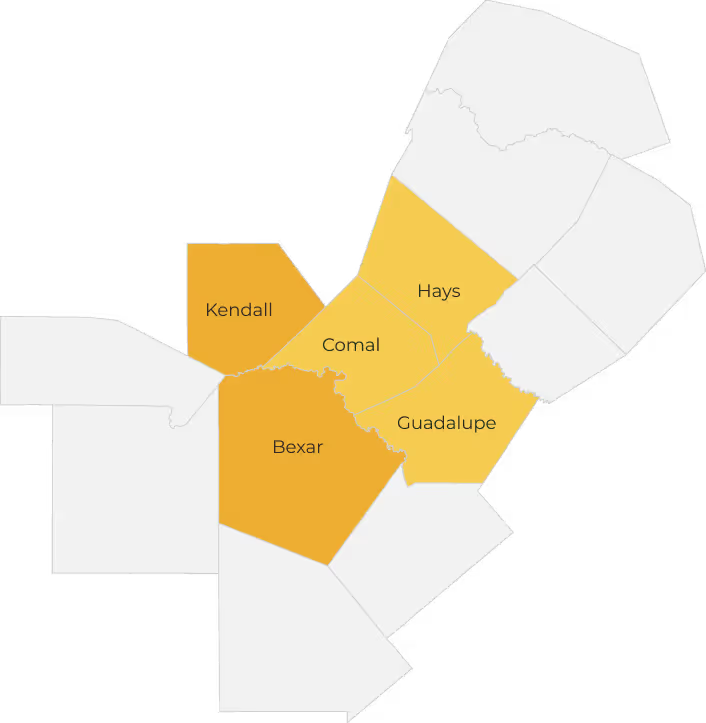
Primary counties:
- Bexar County
- Kendall County
Additional areas:
- Guadalupe County
- Comal County
- Hays County
and surrounding communities.
Frequently Asked Questions
An adjudication means the court found that a minor engaged in delinquent conduct. It is not technically a criminal conviction, and in many cases, the record can be sealed. An adult conviction is a permanent public record with broader, longer-lasting consequences.
At 17, Texas automatically treats the person as an adult. Between ages 14 and 16, prosecutors can ask to move serious felony drug cases to adult court. The outcome depends on the charge, the minor’s history, and the defense presented.
No. Minors have the same Fifth Amendment right to remain silent as adults. Your child should clearly ask for an attorney and say nothing else to police, school officials, or anyone connected to the case.
Yes. School searches follow a different legal standard than police street stops. Campus officers and school administrators often rely on “reasonable suspicion,” not probable cause. That legal distinction matters and should be reviewed early by our attorneys.
A sealed juvenile record usually does not appear on standard background checks. Some government agencies, military branches, and licensing boards may still have access. Avoiding adjudication through diversion or dismissal is usually preferable.
Deferred prosecution allows a minor to complete conditions like drug testing, counseling, or community service in exchange for dismissal. No adjudication is entered. For many first-time offenders in Bexar County, it can be one of the best available outcomes.
No. Prior history makes the case harder and can raise the risk of TJJD commitment or adult court certification, but it does not decide the outcome. A strong defense can still challenge evidence, present mitigation, and limit consequences.

An Arrest at 16 Should Not Define Your Child’s Life at 26
A drug charge filed today is not the end of your child's story. Fowlks Law Firm defends juveniles across Bexar County and the surrounding region with aggressive, thorough representation built around the specific facts of each case. Free consultation. Available 24/7. Spanish spoken.
We will contact you shortly.